
Kitchen Splashback Ideas: Quartz, Tiles, Glass and More
By Barry, Director, Zebra Kitchens and Interiors Last updated 16 November 2026 · 4 min read
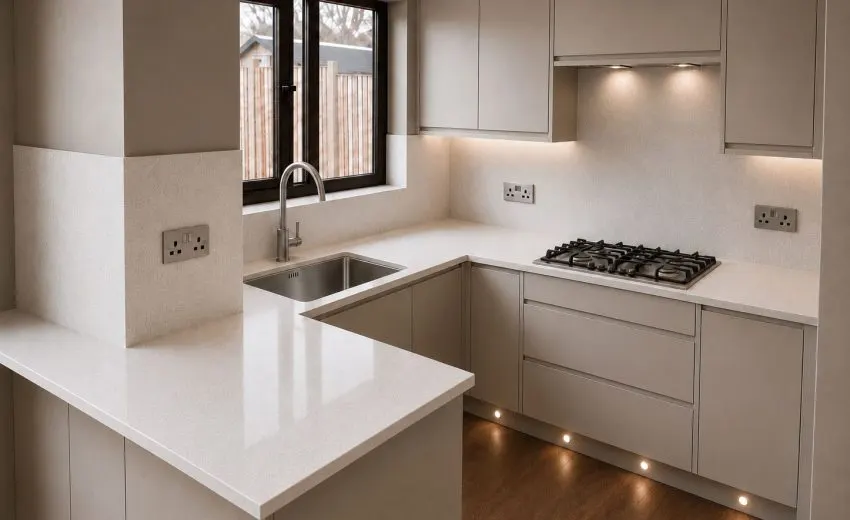
Kitchen splashback ideas need to do more than fill the gap between worktop and cupboards. This is a working surface exposed to cooking splashes, water and regular cleaning. The right choice depends on where it sits, how much maintenance you want and whether you prefer the wall to blend in or become a feature.
I’m Barry, Director of Zebra Kitchens and Interiors. I recommend comparing the full range before choosing: quartz upstands, taller quartz panels, tiles, glass and other suitable surfaces each solve different problems. Start with the practical requirements, then work on colour and pattern.
Kitchen splashback ideas should suit the location
The wall behind a sink has different demands from the area behind a hob. Water resistance, cleanability and heat suitability all matter, but not every product is appropriate in every position. Check the specific surface and appliance instructions rather than relying on a material name alone.
Decide how much wall needs protection. A short upstand may suit a quieter preparation run, while the cooking area may need a taller, suitable surface. Consider steam-producing appliances and awkward corners where splashes collect.
- Identify water, heat and grease exposure on each wall.
- Check the condition and preparation needs of the substrate.
- Mark sockets, switches and any exposed panel edges.
- Agree how the surface will finish at windows and cabinet ends.
Compare quartz upstands with full-height quartz
A quartz upstand is a short vertical continuation above the worktop. It gives the junction a coordinated finish while leaving most of the wall visible. The remaining wall still needs a suitable finish, and an upstand alone should not be assumed to provide all the protection required behind a hob.
A taller or full-height quartz splashback creates a more continuous surface and can make the worktop pattern a major feature. Discuss slab appearance, panel joints, socket cut-outs and installation access. Pattern continuity should be planned rather than promised from a small sample.
Quartz is not immune to heat damage. Suitability and clearances behind the chosen hob must be confirmed against the surface and appliance manufacturers’ requirements before the design is finalised.
Use tiles for texture, pattern and flexible coverage
Tiles offer a broad choice of shape, scale and surface finish. A simple ceramic tile can create a quiet backdrop, while patterned or textured designs bring more visual movement. Large-format tiles reduce the number of grout lines but require careful planning around sockets, corners and exposed edges.
Grout colour changes the result considerably. A close match softens the grid; a contrasting grout makes the laying pattern more prominent. Ask about suitable grout and cleaning products for the chosen tile, particularly around cooking areas.
Natural stone tiles may need sealing and more specific care. Deep texture can hold grease, and some delicate finishes dislike common cleaning products. Choose with the maintenance routine in mind, not just the display board.
Want a second opinion on your own kitchen?
Barry offers a free home visit and free kitchen design, or you can visit the showroom at 181 Walsall Road, Great Wyrley.
Consider glass and other panel materials
Glass creates a smooth surface with relatively few joints and can introduce a clear block of colour. Reflections may brighten the appearance of a room, but they also show nearby fittings and light sources. Discuss samples, backing colour and the requirements for any position close to a hob.
Stainless steel can suit a practical cooking zone, provided you are comfortable with fingerprints, visible marks and the way its finish changes in use. Porcelain and sintered surfaces offer other possibilities, with product-specific fabrication and installation requirements.
Laminate or acrylic panels may be suitable in some locations, but heat limitations vary. Never assume they can continue behind a hob. Ask the supplier and installer to confirm the exact product’s suitability, rather than treating all sheet materials as interchangeable.
Coordinate materials without overcrowding the room
Choose which surface is doing the visual work. Strongly veined quartz worktops may benefit from a quieter wall, while plain worktops can leave room for patterned tiles or coloured glass. Combining several bold patterns can make a modest kitchen feel busy.
You do not have to use one material everywhere. A suitable cooking panel can sit alongside tiled or painted areas, provided the transitions are designed deliberately. Check where joints fall and how thickness differences will be finished.
- Compare door, worktop and splashback samples together.
- View glossy surfaces under the proposed lighting.
- Include grout, trims and socket finishes in the palette.
- Check the appearance from adjoining dining or living areas.
Plan measuring, installation and everyday care
Made-to-measure panels need accurate dimensions and confirmed cut-outs. Ask when final measuring happens, what must already be installed and how the sequence affects completion. Moving a socket after a panel has been made may not be a straightforward change.
The wall condition matters too. Existing tiles, uneven plaster or unsuitable backgrounds may require preparation before the new finish can be installed. Agree responsibility for that work and for the final junctions around worktops, windows and cabinetry.
At Zebra Kitchens and Interiors, we offer a free home visit and free design to help compare the options. Visit 181 Walsall Road, Great Wyrley, to discuss splashbacks alongside doors and quartz worktops. Ask for care instructions for the exact product so your choice remains practical after installation.
Related services, projects and areas
Service: Kitchen Makeovers
Kitchen questions: Kitchen renovation questions answered
Areas we cover nearby: Walsall, Lichfield, Wolverhampton
Frequently asked questions
Is a quartz upstand enough behind a hob?
Do not assume so. The wall protection and clearances must suit the exact hob and surrounding materials. Ask your designer and installer to check the relevant manufacturer requirements.
Are tiles harder to clean than glass?
It depends on the tile texture, grout and glass finish. Smooth panels have fewer joints, while tiles vary considerably. Compare the actual products and their care instructions.
Can I mix a quartz upstand with tiles?
Yes, if the junctions and proportions are planned. Consider where the tiles begin, how edges finish and whether the combination adds useful detail or unnecessary visual lines.
Can a splashback be replaced without changing the worktop?
Sometimes, depending on how the existing material is fixed and the condition beneath it. Removal can reveal damage, so have the worktop edges and wall assessed before ordering a replacement.
Related guides
Free kitchen design: what to expect from Barry
Free kitchen design from Zebra: what happens at the home visit, how Barry measures and plans your room and what you get before you decide to go ahead.
Practical galley kitchen ideas for a workable layout
Explore galley kitchen ideas for clear walkways, useful storage and better lighting. Plan your layout with Barry at Zebra Kitchens in Great Wyrley today.
Glass splashback kitchen ideas: colour, care and fitting
Explore glass splashback kitchen ideas, from colour samples to sockets, cleaning and fitting. Get practical planning advice from Barry at Zebra Kitchens today.
Free kitchen design with Barry
Tell us a little about your kitchen and Barry will be in touch.
07488 431099181 Walsall Road, Great Wyrley, Walsall WS6 6NL